• Skip to primary navigation
  • Skip to main content

VRSUN

Hot Virtual Reality News

HOTTEST VR NEWS OF THE DAY

  • Home

VR Development

Meta & Stanford Reveal Ultra-Thin Holographic XR Display the Size of Glasses

July 30, 2025 From roadtovr

Researchers at Meta Reality Labs and Stanford University have unveiled a new holographic display that could deliver virtual and mixed reality experiences in a form factor the size of standard glasses.

In a paper published in Nature Photonics, Stanford electrical engineering professor Gordon Wetzstein and colleagues from Meta and Stanford outline a prototype device that combines ultra-thin custom waveguide holography with AI-driven algorithms to render highly realistic 3D visuals.

Although based on waveguides, the device’s optics aren’t transparent like you might find on HoloLens 2 or Magic Leap One though—the reason why it’s referred to as a mixed reality display and not augmented reality.

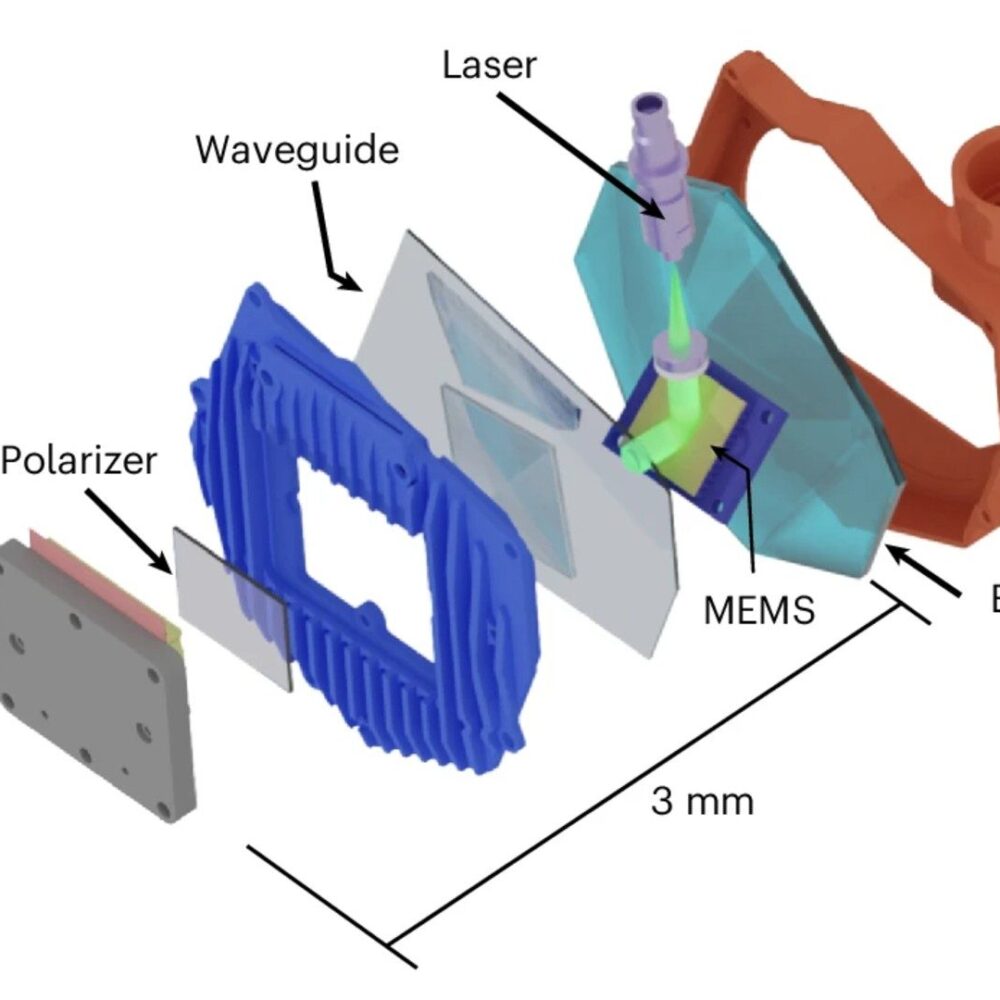
At just 3 millimeters thick, its optical stack integrates a custom-designed waveguide and a Spatial Light Modulator (SLM), which modulates light on a pixel-by-pixel basis to create “full-resolution holographic light field rendering” projected to the eye.
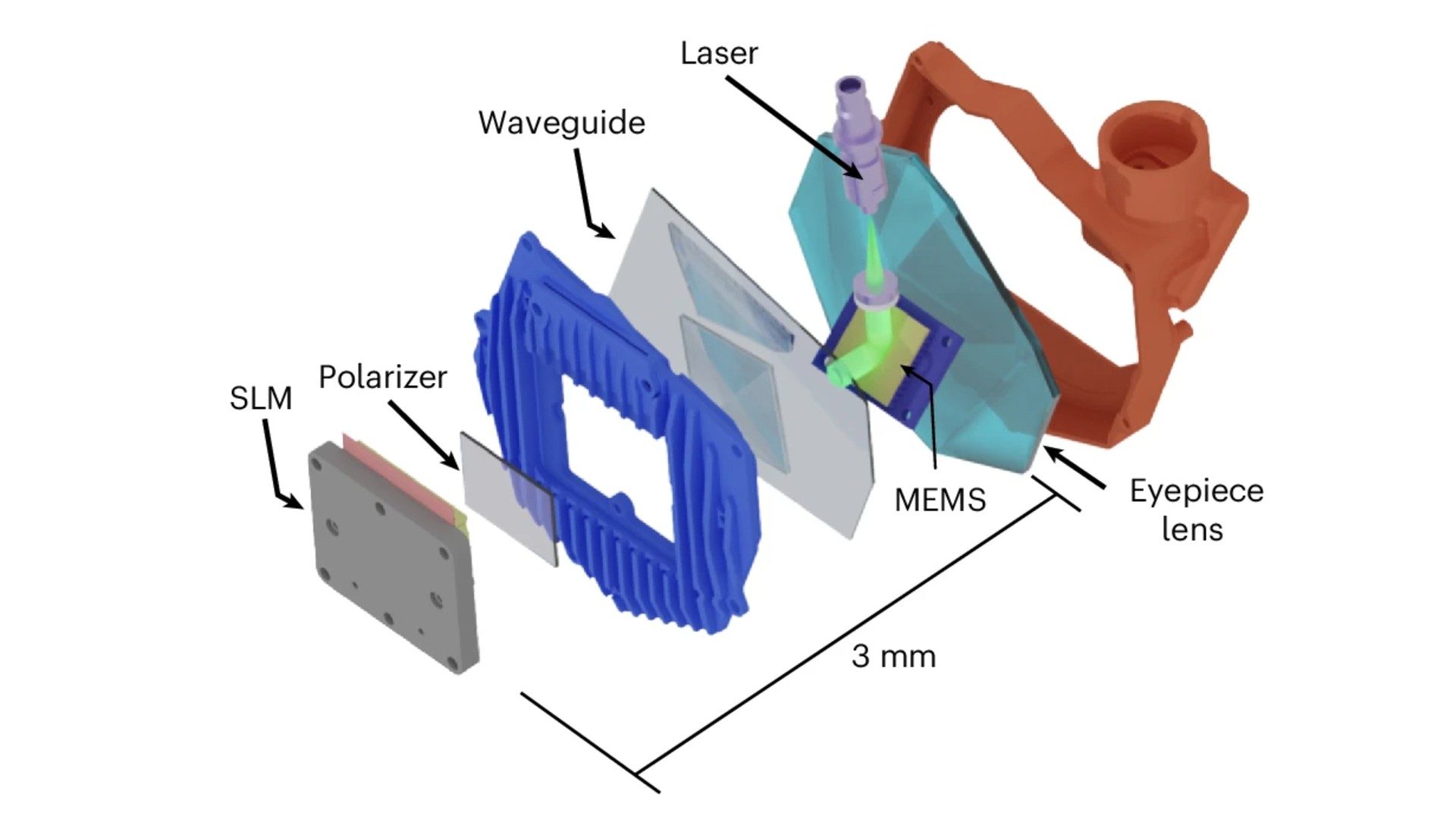
Image courtesy Nature Photonics

Unlike traditional XR headsets that simulate depth using flat stereoscopic images, this system produces true holograms by reconstructing the full light field, resulting in more realistic and naturally viewable 3D visuals.

“Holography offers capabilities we can’t get with any other type of display in a package that is much smaller than anything on the market today,” Wetzstein tells Stanford Report.”

The idea is also to deliver realistic, immersive 3D visuals not only across a wide field-of-view (FOV), but also a wide eyebox—allowing you to move your eye relative to the glasses without losing focus or image quality, or one of the “keys to the realism and immersion of the system,” Wetzstein says.

The reason we haven’t seen digital holographic displays in headsets up until now is due to the “limited space–bandwidth product, or étendue, offered by current spatial light modulators (SLMs),” the team says.

In practice, a small étendue fundamentally limits how large of a field of view and range of possible pupil positions, that is, eyebox, can be achieved simultaneously.

While the field of view is crucial for providing a visually effective and immersive experience, the eyebox size is important to make this technology accessible to a diversity of users, covering a wide range of facial anatomies as well as making the visual experience robust to eye movement and device slippage on the user’s head.

The project is considered the second in an ongoing trilogy. Last year, Wetzstein’s lab introduced the enabling waveguide. This year, they’ve built a functioning prototype. The final stage—a commercial product—may still be years away, but Wetzstein is optimistic.

The team describes it as a “significant step” toward passing what many in the field refer to as a “Visual Turing Test”—essentially the ability to no longer “distinguish between a physical, real thing as seen through the glasses and a digitally created image being projected on the display surface,” Suyeon Choi said, the paper’s lead author.

This follows a recent reveal from researchers at Meta’s Reality Labs featuring ultra-wide field-of-view VR & MR headsets that use novel optics to maintain a compact, goggles-style form factor. In comparison, these include “high-curvature reflective polarizers,” and not waveguides as such.


Filed Under: AR Development, News, VR Development, XR Industry News

Sharp Unveils Prototype VR Controller, Combining Haptic Gloves & Standard Buttons

July 22, 2025 From roadtovr

Sharp announced it’s releasing a prototype VR haptic controller in Japan, which aims to reproduce the sense of touch in VR while serving a familiar button layout.

Japan-based Sharp says its VR haptic controllers can let users sense texture thanks to “multi-segmented tactile elements” placed on the device’s fingertips. Various vibration patterns on the surface are meant to convey different textures, such as smooth, rough, etc., the company says.

“Although the haptics are not at a level that reproduces the real thing, by changing the parameters we have been able to achieve a variety of tactile sensations,” Sharp says on the project’s Japan-facing website. “Rather than leaving it in-house until the developers are satisfied with it, we plan to work with our users to improve the quality of the content.”

Image courtesy Sharp

Sharp says the device, which will arrive in a left and right pair, “does not allow for delicate finger tracking like glove types.” It also lacks force feedback, or any sort of temperature feedback.

The prototype is supposed to also function like a standard controller, including sticks and buttons, the company says. One thing that isn’t clear though is how the gloves will be tracked, which Sharp says could include mounts for “high market share” tracking standards.

Sharp says the device is currently undergoing demonstration experiments, so it’s not clear whether it will eventually be commercialized; we haven’t seen anything beyond renders at this time. The company is aiming to put early iterations of the device in the hands of the paying public though, at least in Japan.

The company recently closed pre-registrations through its Japan-facing website, pricing units at ¥100,000 (~$680). “Please note that development or release may be canceled,” the company warns.

Granted, Sharp has more experience in XR than you might think. As the leading OEM supplier of high-end VR displays, at one time Sharp was the top display supplier for Meta Quest 2. In late 2024, Sharp and Japan’s largest telecom NTT Docomo also launched a pair of AR glasses, called MiRZA.

Filed Under: News, VR Development, XR Industry News

Pico Reportedly Developing Slim & Light Mixed Reality ‘Goggles’ to Rival Next-Gen Meta Headset

July 18, 2025 From roadtovr

Pico, the XR headset maker owned by TikTok parent ByteDance, is reportedly developing a mixed reality device aimed at rivaling Meta’s next-generation XR headset.

According to a report from The Information, Pico is currently working on a pair of mixed reality “goggles” codenamed ‘Swan’, which are said to be thin and lightweight—reportedly weighing around just 100 grams.

Citing three people with direct knowledge of the project, The Information reports that the device features a hybrid design that offloads processing to a tethered compute puck. This approach allows the glasses portion of the device to be significantly thinner and lighter than current-generation XR headsets like the Quest 3 or Pico 4 Ultra.

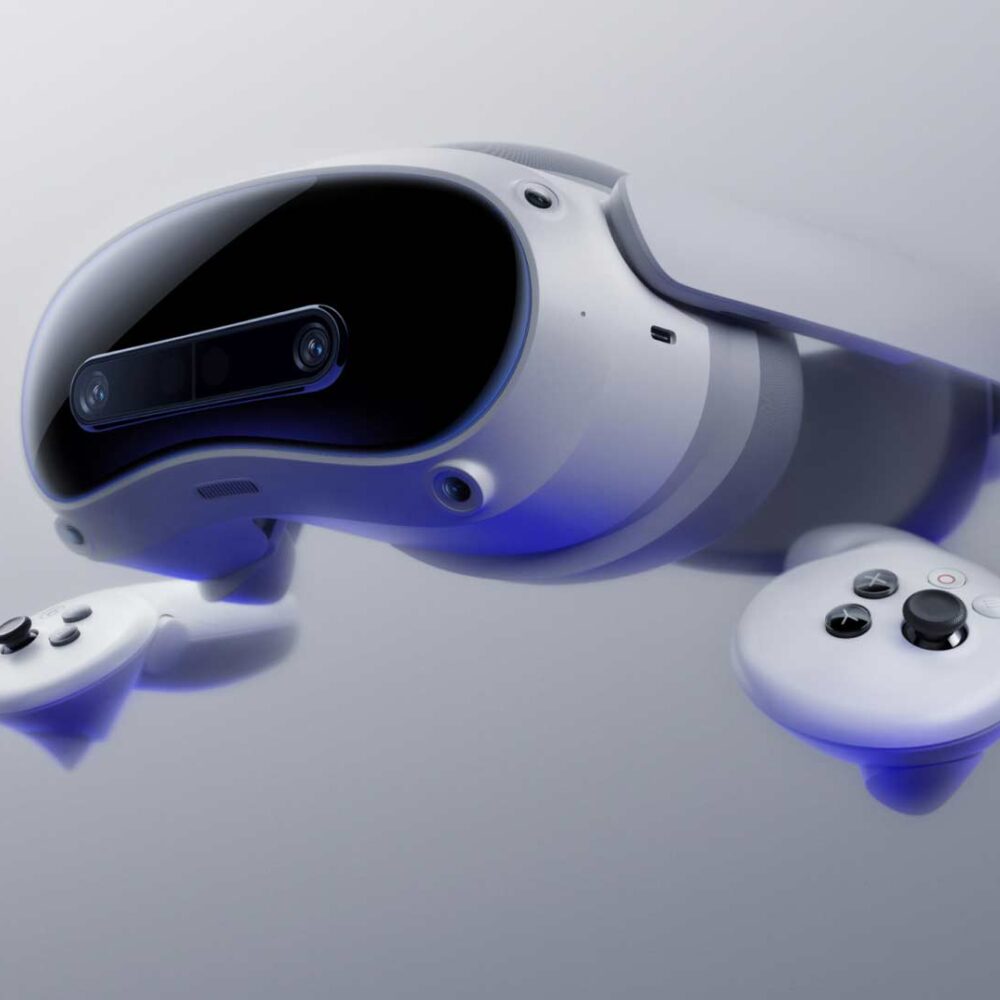
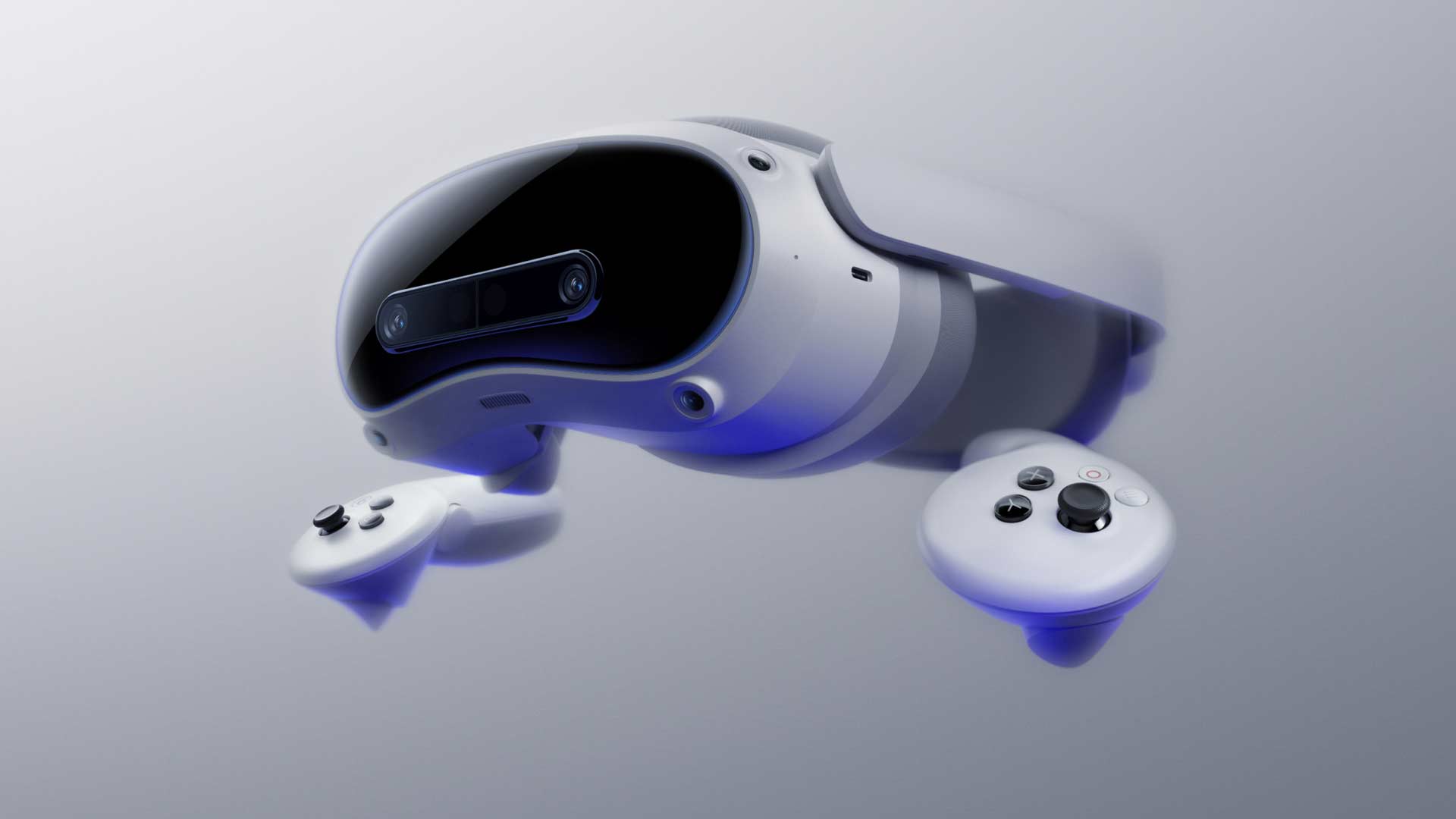
Pico 4 Ultra | Image courtesy Pico

Swan is also said to rely primarily on eye and hand tracking for input, moving away from physical controllers. Furthermore, the report notes that Pico is developing “specialized chips for the device that will process data from its sensors to minimize the lag or latency between what a user sees in AR [sic] and their physical movements.”

Swan is said to be conceptually similar to Meta’s reportedly upcoming mixed reality device codenamed ‘Phoenix’, which also includes a compute puck and a glasses-like form factor. According to a recent Wall Street Journal report, Meta’s headset could launch in either 2026 (WSJ’s estimate) or 2027 (as cited by The Information) and may cost under $1,000.

The codename itself is still a matter of speculation: The Information refers to Meta’s headset as ‘Phoenix’, while the WSJ uses ‘Loma’, and online sources have also mentioned ‘Puffin’.

That said, there is currently no information on what Swan will cost or where it will ship. In the past, Pico’s consumer headsets have typically been priced slightly above Meta’s equivalents and have been available primarily in East and Southeast Asia and Europe—but not in North America.

Filed Under: News, VR Development, XR Industry News

« Previous Page

  • Home